A “don’t rock the boat” theory of political change

You’d think that as long as we’ve known Trump and Clinton it would be more obvious which is better (okay, least bad). But here we are. That said, I largely agree with Brandon’s thoughts: Hilary is the better of the two. If we’re thinking about the trajectory of freedom in this country, it’s like we had been climbing an upward path till 9/11 gave military-industrial complex a new project. Clinton is offering to keep leading us down a gentle incline and Trump is saying “let’s go through that thicket of poison oak!”

I stand by my old advice that a vote for the big two parties is a wasted vote.  People will argue that in swing states it might be close and you might regret your vote. Those people are really arguing that you might regret the vote of hundreds-thousands of strangers. Your vote still is not decisive. Even if you convince a thousand strangers in a swing state to vote your way, you’re still highly unlikely to affect the outcome.

I think, in terms of voting, you do much more good by sending a Johnson signal than you do by slightly increasing the margin by which Clinton wins (or slightly decreasing the margin by which she loses depending on your state).

But my advice is given in the context of a world where Johnson is expected to get 6% of the vote. That affects my cost-benefit calculus. What would it mean for the long-run success of liberty if Johnson were to actually win?

To build on Brandon’s third point (“Clinton is a lawyer and she knows how our government is supposed to work”), this isn’t just a competition to get into the white house. It’s a sales pitch that requires buy in from the electorate. If Johnson won the election, he’d be in the position of some newfangled gadget America bought on a whim. He could catch on, like the microwave, or sink like the Segway.

czgldopviaa-rh
Onward, to freedom!

Truthfully, I’m not sure that scenario would be that good for freedom–I think Johnson is a pretty good voice for liberty, and a great third party candidate. But if he actually won, I think he might be too different from the environment he’d have to operate in. It could turn people off of libertarianism for another generation.

But then, the point of your vote isn’t to pick the winner, it’s to express your political beliefs. You’ll do a much better job of voting by voting your conscience than by trying to vote strategically. So vote for Johnson, but root for Hillary… this time.

Voting For Potty-Mouth Trump

I think Donald Trump has the attention span of a two year-old and the potty mouth of a six year-old reared by an indulgent grandmother who is also hard of hearing. I also think he is deeply ignorant on a very important issue (international trade) and I disagree forcefully with him on another (illegal immigration from the south). Finally, I believe there is little chance that a President Trump’s foreign policy would reverse the Obama precipitous decline of the US on the world stage, which I think is dangerous for Americans.

Not a pretty picture overall. So, it takes serious concerns for a dedicated, generally well-informed rationalist like me to vote for him. Here are the reasons why I will.

First, Trump has already told us whom he would appoint for the Supreme Court which sets the life conditions of American society for a generation or more. All his potential appointees are fine by me. It’s not difficult to guess that no Clinton appointee would be acceptable, not one, zero. Any of them would facilitate the creeping abrogation of the US Constitution we witnessed under Obama.

Second, I am certain – because it’s difficult to imagine otherwise – that a President Trump would try to stop and reverse most the climate change cult nonsense and relegate it to the level of a private religion where it belongs. His administration would allow an energy revolution sufficient in itself to rekindle economic growth. I see no prospect of normal economic growth under a Hillary Clinton presidency. (I mean 3% per year and over.) She has said herself that she would continue Pres. Obama’s paralytic policies.

Third, through the example of his sheer verbal brutality, Trump would lift some the yoke of political correctness. This is not a superficial or a light reform. I believe that political correctness actually paralyzes Americans’ criticality on nearly all issues. (Examples on request.)

My last reason is Democratic candidate Clinton of course, even if I leave aside every single one of the leftist policies she is likely to try to implement. Mrs Bill Clinton is still bought and paid for. The fact that I don’t know exactly by whom or by what only makes it worse. (Someone who would not braggingly share her $250,000 a shot speeches with the public is unthinkable to me.) On that account alone, if I had to choose between H. Clinton and Al Capone for president, it would be a toss-up. We know what interests Al was serving, after all.

There is worse: Her lies about her lies, her lies that have zero chance of being believed have become a proof that she is delusional, at least part of the time. By contrast, Trump ‘s untruths are like those of a little boy who can’t help himself from opening his mouth before he talks.

Presidential elections are not only about the presidency, of course. They give the winner’s party a confirmation of the validity of the principles it proclaims and of the policies it embodies. This is obviously true for well defined policies such as Obamacare. It’s true, more subtly, about cultural policies both explicit and implicit. Seven and half years of Obama administration have established firmly – with Big Media complicity – the language of envy and the spirit of beggardliness in American political discourse. Public speech is now built around platitudes, clichés, half-truths, and big lies repeated so frequently that they have become truth, Goebbels-style. The new liberal language is disgusting but completely predictable and thus boring. It’s also a form of child abuse. (Individuals who were 10 during Pres. Obama’s first campaign are now 19. They have never known public sanity.) As for Demo principles, there aren’t any. I count my blessings!

Donald Trump on his part, is his own buffoon. He is only an epiphenomenon. His objectionable traits are not part of a cultural movement. He is not contagious. There is zero chance the Republican Party, or the conservative movement are going to adopt his crudeness. Neither could if they tried.

I am angry about this cultural deterioration because I believe that in the long run what people do, what they accomplish collectively, is strongly constrained by culture. The contemporary American left-liberal culture shackles the imagination, and by doing so destroys many possible futures. Again, the Obama/Clinton conceptual swamp is vastly more of a lasting threat to America than the childish vulgarity and the ignorance Trump displays so frequently.

Being on the side of Trump often puts me in embarrassing company, I admit. But being on Clinton’s side would place me knowingly in vicious company. It would also range me squarely on the side of an intellectual class that has spent decades consolidating its collective blindness and its collective deafness about the reality of the world. It’s a class I know well because much of it lives in universities. There is no doubt that Trump as president is a big gamble. But Clinton is no gamble at all; her evilness is predictable.

Sometimes, to be a man of conscience, you have to gamble. That’s what I plan to do, on my behalf and on your behalf.*

* Public persons often contribute unwittingly to me finding my bearings: If Harry Reid, the corrupt real estate and proud deliberate liar loudly condemns Trump, there has to be something right about supporting Trump.

Voter Participation: Something Has to Be Done

In California, 70% of eligible voters are registered, and 47% of those turned out in a recent election. Thus about a third of those who could vote do so. These are dismaying numbers.

Dismaying because they are too high.

Why? First, some more dismaying numbers:

When Newsweek recently [2011] asked 1,000 U.S. citizens to take America’s official citizenship test, 29 percent couldn’t name the vice president. Seventy-three percent couldn’t correctly say why we fought the Cold War. Forty-four percent were unable to define the Bill of Rights. And 6 percent couldn’t even circle Independence Day on a calendar.

Too many ignorant fools are casting votes. People who believe that minimum wage laws create wealth, free trade destroys wealth, or clergymen should be forced to marry gay couples, to pick just a few examples. We need to bar these ignoramuses from the voting booth.

How? For starters, ditch the 26th amendment to the Constitution and the raise the voting age to at least 30. Get the 20-somethings out of the way; too many still believe in free lunches.

Second, change the 24th amendment to require poll taxes rather than forbid them. There is no justice in forcing non-voters to pay election costs.

Third, institute stiff qualification exams. Voters need know the vice president’s name, understand the Cold War, identify July 4 as Independence Day, and a whole lot more. Informed voters would be mostly immune from pandering demagoguery.

Disenfranchisement will lead to alienation and rebellion, some will say. Perhaps, and this could be alleviated by a phase-in of the changes. But then voting will become a privilege that young people can aspire to, as they might aspire to a corporate management position.

Another objection: my proposal is elitist. Of course it is! If there’s one thing we desperately need in this country, it’s a reversal of the egalitarian sentiments that have poisoned so much public discourse. We need to encourage and acknowledge the best and the brightest. Ignorant fools should not be allowed to operate dangerous machinery or pull levers in voting booths.

I wish I could just list every idea I’ve encountered then never cite anything…

Steve Horwitz has a great piece in the Freeman that I wish I’d written. The tl;dr: Voting isn’t all there is to political participation. This is an idea that’s been bouncing around in my head as I’m constantly remound that I’m now an American citizen (sorry everyone else in the world…) and that this November I’ll be eligible to vote for who I think should foster anti-American sentiments internationally (Republicans) or  domestically (Democrats).

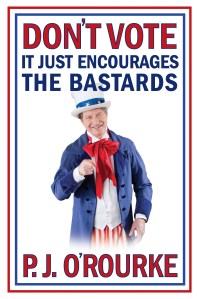
The other day I said I’d consider voting but I couldn’t recall whose name I’d write in (turns out it’s Willie Nelson*). But my usual response to any question about whether I’ll vote is “No, it just encourages the bastards.” When that’s countered with “blah blah blah civic engagement blah blah” I retort with,essentially, Horwitz’s point: My vote is not going to change the outcome**, but I can contribute value by trying to convince my students that economics matters and that a vote for third party candidate (even a Green Party vote) does more good than a vote for the big two.

I don’t know where I picked up that idea, but if I’d remembered, I would have posted his piece here before he did. Even better would be if I could just list a repository of everything I’ve ever read (or heard) in some public place and just write and write without worrying about citing anything.

Continue reading

Fifty Years of Voting

I cast my first vote in 1964, shortly after turning 21, the legal voting age in those days. I voted for Barry Goldwater who, although he described himself as a conservative, didn’t fit that category by today’s standards. He was for free markets but he was not particularly religious and he held a laissez-faire attitude toward alternate lifestyles. He was, unfortunately, a war hawk, so he wouldn’t fit very well into today’s libertarian category, either.

Four years later I voted for Richard Nixon, sad to say. I somehow thought he was for free markets, being a Republican. I was cured of that delusion by a wakeup call at 8:15 AM on Monday, August 16, 1971. That was the moment I saw the headline in the L.A. Times announcing Nixon’s dastardly Sunday evening perfidy: price controls, closing the gold window, and an import tariff surcharge. All of these statist actions very quickly played out disastrously. Their personal import was to cure me of any notion that Republicans were necessarily friends of liberty. I became a libertarian that Monday morning and never looked back.

Of course that decision meant never again voting for a winner.  I voted for John Hospers in 1972, and he actually got one electoral vote from a renegade Republican elector, Roger MacBride, who was the LP candidate in 1976. Ed Clark’s 1980 campaign on the Libertarian ticket, generously funded by the Koch brothers, gave me brief hope for the new party, which we all know has come to naught. I’ve “wasted” my vote on Libertarian candidates ever since. Thanks to Proposition 14 in California, I can only vote for Libertarians in the primary elections; minor parties are shut out of the general election. In many races the general election is a contest between two Democrats. I resist any urge to vote for the lesser evil of the two so now I just leave most of my ballot blank and vote against all tax measures.

If we must have voting, I offer a couple of common-sense reforms:

  • Raise the voting age to 30. People under that age are clueless.
  • Require voters to pass a stiff qualification exam, something far more rigorous than the simple literacy tests of yore.
  • Institute a stiff poll tax, at least enough to cover election costs. Why force non-voters to pay?

I’m tempted to throw in land ownership as another criterion, but the foregoing should suffice. Of course this reform would leave many people feeling disenfranchised, but so what? Most people are far too ignorant to judge issues and candidates rationally and should be kept away from voting booths at all costs. Anyway, the system would leave a path open for people to earn enfranchisement by working hard to satisfy the above criteria.

Would I apply for enfranchisement under my proposed system?  No way; I have better things to do.  Will I vote this year?  I suppose so. I have no idea what will be on the ballot, but there will doubtless be some lame-brain propositions to vote against.

Rational ignorance and institutions

I’m grading a question I gave to my class on rational ignorance so I’ve been restating myself repeatedly… and in doing so refining my view on rational ignorance.

Here’s the basic story: an election is forthcoming and we need to decide how we will vote. One possibility is that we follow heuristics (such as “I’m going to vote for the Democrats”). Another is that we delve through all the available information and make a calculated decision based on what we expect will be the outcomes of each candidate’s proposed policies (or what we think their policies actually will be). In a perfect world the median voter would be making a decision on the second basis. But each voter faces an opportunity cost of being more informed. And because a tie is highly unlikely I can cast a ballot I might otherwise regret but I won’t have to worry that it will actually change the outcome of the election.

The outcome is that people vote stupidly. But if that were really the problem it wouldn’t be that big a deal. Yes, people are wasting their votes. But really, we’re not facing a situation where “the truth” is on the ballot. The real problem is that the terms of political competition aren’t what we want them to be. This is still a Prisoners’ Dilemma, but the outcome isn’t “we all accidentally vote for the jackass.” The outcome is “the competition is inescapably between jackasses.”

In a world where rational ignorance were a problem because of the ignorance part political races would still be about a reasoned debate about how to improve the world. But that isn’t what politics is (and it probably never was). Instead it’s about marketing. It’s about grabbing the scarce attention of voters that has little if anything to do with information or anything you can be ignorant about.

In other words, rational ignorance is not an epistemic problem, it’s an institutional problem. It does not simply change the intelligence of the outcome of a vote, it reduces the role of intelligence and rationality in elections. It changes the rules of the game so that a politician’s efforts towards being “right” have little bearing on their success. What really matters is garnering the irrational support of voters.

Some Thoughts on Voting

A while ago I bought a Willie Nelson album because Willie is excellent. People who say “I don’t like country music” haven’t listened to Willie Nelson.

Willie would be the first pig-tailed president. We must elect him for social justice!

Even though I can get the album without paying for it, I paid because I want to tell Willie Nelson that I appreciate him. But my purchase was also a dollar vote (a five dollar vote, really) telling would-be musicians to be more like Willie Nelson.* For undertaking the expense of making that vote, I even got access to the album through Amazon. That’s good if I want to load it onto my phone for a road trip, but most of the time it’s actually easier for me to listen to that album on Grooveshark. In any case, I got to express myself, listen to Willie Nelson in a barely easier fashion under some circumstances, and it only cost my $4.99.

Now let’s do some lazy economics. My cost of expressing my preferences was approximately $5. If I’m rational we can infer that my benefit was at least as great. I got access to the album (that’s worth about 2 cents to me), I got to express my appreciation of Willie, and I got to make an infinitesimally small impact on the artistic landscape.

I think it’s fair to say that people who vote are doing so to express their views (as I did). But I think they usually vote for the wrong person. If I decide candidate Bob is less terrible than candidate Andy, that doesn’t mean I should vote Bob. I think candidate Carol actually reflects my views fairly well, and I’m sure she won’t win the election. But I also know that if either Andy or Bob wins, it will be by 300 or more votes**; so if I vote for Carol I won’t change the outcome and thus won’t be “wasting” my vote. In fact, if I vote for Bob I’m wasting my vote because I’m sending the message that we need less of the stuff Carol calls for and more of the stuff Bob does.

But in any case, we all pretty much understand that while your vote matters on average, it doesn’t matter on the margin. Put simply, the costs of voting are significantly higher than the benefits you would get if your vote magically actually did change the outcome multiplied by the probability that such a miracle occurs. So probably people vote to express themselves, and as long as their doing that, voting for the Republicans (Democrats) is like buying a popular album you hate because there’s another popular album you hate more. Don’t do that!

* Being more like Willie Nelson doesn’t mean impersonating Willie, it means being excellent.

** In an election with fewer than 5000 voters you might actually have a reasonable chance of affecting the outcome, but if you aren’t voting in a small town election you can safely assume that your vote won’t determine the winner.

Election Reform: a Modest Proposal

Texas and other states have passed laws requiring voters to present valid ID at their polling place.  How could this be controversial?  These days we have to present ID to get on Amtrak, pick up mail at the post office, transact with a bank teller, etc., etc.  Is proper ID any less important for voting?  But a court recently struck down the Texas law saying it impacts minorities disproportionately.  Hummph.  If laws against aggravated assault affect minorities disproportionately should those be overturned also?

But why bother about this issue?  There surely is some voter fraud happening, but how much does it matter?  The real problem with democracy is simply the results.  The worst get on top, as Hayek put it, Exhibit A being, of course, the Sewer Rat in the White House.  As the electorate has broadened, starting with white male landowners at the Founding all the way down to today’s situation where anyone with a pulse who is at least 18 and claims to be a citizen can vote, and with direct election of senators in between, the quality of elected officials has gone steadily downhill.  Barack Obama!  Harry Reid!  Mike Huckabee!  Nancy Pelosi!  Compare this crew with George Washington, James Madison, Thomas Jefferson.  Are you sick at your stomach yet?

Herewith a modest reform proposal:

  1. Raise the voting age to 30
  2. Disqualify all government employees and all recipients of any government entitlement: social security, medicare, etc.
  3. Adopt a stiff qualification exam, to be re-taken every five years
  4. Mandate a poll tax sufficient to cover election expenses

Let’s now consider objections one by one:

Objection: people would feel disenfranchised. People who lost their vote would be bummed, no doubt, but they would still have the prospect of earning a vote to aspire to.  Voting would be seen as a privilege to be earned, and the quality of votes cast would skyrocket as would the quality of campaign rhetoric.

So as not to cause too much upset, the voting age could be raised gradually and the poll tax raised in steps.

Objection: corruption. It might be worthwhile for special interests to track down individual voters and offer them bribes or intimidation.  But if the voter roles were shrunk by a factor of a thousand, for the sake of argument, that would still leave a hundred thousand or so voters nationwide.  That leaves quite a bit of effort for lobbyists and other crooks to track them all down.

Besides, corruption is proportional to the amount of power that resides with government.  Regulation of lobbyists, campaign reform and all that will never mean anything as long as so much money and power are at the disposal of politicians.  My voter reform proposal will lead to a drastic shrinkage of government and thus drastically reduced rent-seeking opportunities and incentives.

Furthermore, as things stand with campaign promises.  How much worse would outright cash bribes be?

Objection: bias. Outcomes would be skewed toward the viewpoints of the eligible voters, which would not be representative of the general population.  Exactly!  The whole point is to restrict voting to an elite who can think and act rationally and not be swayed by the sort of demagogic appeals we hear from the aforementioned politicians and their ilk.

Is this idea likely to gain traction?  Not any time soon, but it’s fun to speculate.  An interesting alternative is Fred Foldvary’s “cellular democracy.”  Perhaps he’ll be moved to post that idea here.

Don’t Vote?

Philosopher Jason Brennan gives us a thought exercise concerning voting:

Imagine 12 people are serving on a jury in a murder case. The prosecution and defense present evidence and call witnesses. The court asks the jury to reach a verdict. They find the defendant guilty.

Suppose four of the jurors paid no attention during the trial. When asked to deliberate, they were ignorant of the details of the case. They decided more or less at random.

Suppose four of the jurors paid some attention to the evidence. However, they found the defendant guilty not on the basis of the evidence, but on wishful thinking and on bizarre conspiracy theories they happen to believe.

Suppose four of the jurors paid attention to the evidence. However, they found the defendant guilty because he is an atheist, while they are Christians. Like many Americans, the jurors trust atheists no more than they trust rapists.

Do read the whole thing to find out why voting in a mass democracy is not necessarily something that should be automatically assumed to be good (or to go to war over, for that matter).

Co-blogger Warren Gibson has a great take on voting as well.

Vote! Or not.

We have an election in California next week.  I offer two gloomy premises about voting:

  1. My vote doesn’t matter.
  2. The outcome doesn’t matter.

As to premise #1, have you ever voted in an election that was decided by one vote?  The odds favoring that outcome are somewhere in the lottery-winning range. The standard objection is, “what if everyone felt that way?”  My answer is, I don’t control everyone, just myself.

As to premise #2, I should say the outcome matters very little.  For many years I deluded myself that Republicans would hold back the tide of collectivism.  What was I thinking?  George Bush, who I would concede was a decent man, made a lot of mistakes and did a great deal of harm.  Must I elaborate?  The wars, the Patriot Act (an Orwellian name if there every was one), torture of “detainees,” the social security drug benefit, and worst of all, setting the stage by his failures for the current White House occupant who I take to be hell-bent for fascist dictatorship. Notwithstanding these premises, I’m going to vote as I always do.  I’ll tell you why at the end.  First a little about next week’s ballot.

I registered Republican in 2008 so I could vote for Ron Paul but then switched back to Libertarian. I find that in the Presidential primary, I can choose from no fewer than nine candidates on the Libertarian ticket.  I thought Gary Johnson already got the nomination at the convention.  What’s this vote all about?

This year California’s new “jungle primary” system takes effect. Now anyone can vote for candidates of any party in the primary (excepting Presidential choices), and the top two vote-getters, even if they are of the same party, will appear on the general election ballot.  This is supposed to make races more competitive but I think it will do the opposite – move us closer to a one-party state.  We’ll see how many of the general election races offer a choice of two Democrats (or in a few districts, perhaps two Republicans).
Leafing through the voter information pamphlet, I find a stew of 24 Senate candidates: six Democrats, 14 Republicans, two Peace & Freedom, and one each American Independent and Libertarian.  Incumbent Dianne Feinstein will win the primary and the general election without mussing a hair of her signature coiffure, and with so many Republicans competing with one another, it’s likely a Democrat will come in second and appear on the general election ballot along with Senator F (who can be quite sensible at times, for a Democrat).

I’ll vote for the Libertarian, the perennial Gail Lightfoot.  The Libertarian Party needs to draw enough votes in each election to keep its status as a qualified party, and it knows that a female name always draws a certain number of votes, and an American Indian name adds a few more.

Not much choice for Congress: the Democratic incumbent, another Democrat, and a Republican.  The other Democrat is a bit of a nut case, so it might be fun voting for him.  On second thought, I’ve never voted for a Democrat in my whole life, so why start now?  The Republican shows a faint libertarian spark.  I suppose I’ll vote for her.

Ours is the only county in California whose supervisors (county legislators) are elected by districts.  Yet every county voter gets to vote in all the districts.  Bizarre.  I did notice that one candidate opposed building a new jail.  I’ll vote for him and leave the rest blank.  I don’t want to become confused or discouraged by learning any of his other positions.

There are two state propositions, a dumb one about term limits and a $1 per pack cigarette tax.  Why not just send all the smokers to the gas chambers?  On second thought, we need to keep them alive so we can work them as slaves.
Three county tax measures are automatic noes.

So why will I vote?  I can only muster two reasons:

  1. With so many people voting by mail, they have consolidated the voting places.  Mine is now a mile away.  I like that because if the weather is good I’ll have a nice hike through the open space to get there.
  2. I feel some sort of emotive satisfaction in voting.  We all like to believe we are having our say when voting, preposterous as that notion is. For many young people, voting for Barack Hussein in 2008 was a positive expression of hope, which one hopes has been wrung out of all but the densest of them by now.  I felt that same youthful enthusiasm when casting my first-ever vote, for Barry Goldwater in 1964, so I understand.  But now the satisfaction, as you can tell, is thoroughly sardonic.

Not only will I vote, but I have actually contributed to candidates: Ron Paul, Gary Johnson, and Art Robinson who is running for Congress in Oregon.  I offer no excuse for this behavior.  I herewith publicly  resolve to make no further donations this year.

It gets worse.  I twice ran for office, once coming perilously close to winning.  That memory is too painful so I won’t elaborate.

In November I will vote for Gary Johnson.  Knowing that B.O. will carry California I needn’t worry about whether Mr. Romney might make a slightly less evil President.  There will be nasty state tax increases to vote against as well.