Eye Candy: the US Asian population, circa 2010

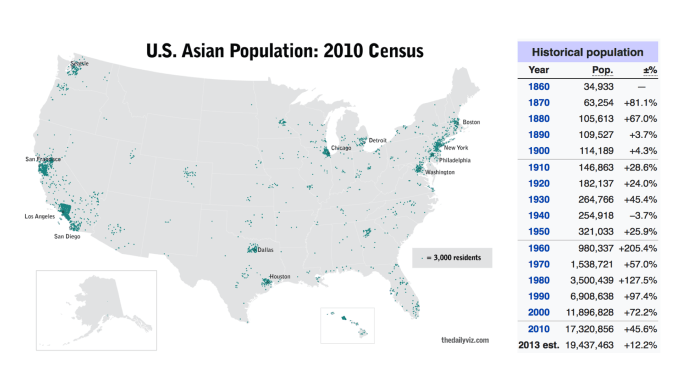
NOL map US Asian population
Click here to zoom

“Asian” is a pretty broad term. Racial classifications are, perhaps, the dumbest thing in the world.

Imagine seeing something like this in the press today, or this as an advertisement. There’s been lots of progress in this country, it’s just hard to see sometimes.

Nightcap

  1. The Russian view of Syria and Israel Michael Koplow, Ottomans and Zionists
  2. It’s time to end one-size-fits-all approach to aid Seth D. Kaplan, American Interest
  3. How the Syrian protests spiraled into savagery Ian Birrell, Spectator
  4. Historians can’t seem to catch up to urbanization Michael Goebel, Aeon

Revisiting Epstein’s Freedom and Growth


I was fortunate to be invited give the Epstein Lecture at LSE this March. The series is named after the great LSE economic historian Larry (Stephen) Epstein. Here I’ll summarize why it was such an honor to give the lectures. The content of the lecture will be another post.

Epstein was a historian whose origin field of expertise was medieval Italy. I encountered him through Freedom and Growth. Published in 2000, I first read it a couple of years later, perhaps in 2002 or 2003. At the time I was devoted to a story of economic growth shaped by Douglass North, particularly Structure and Change in Economic History (1981).

The focus of Structure and Change was on transaction costs. High transaction costs limited market exchange and kept societies poor for most of history. Sustained economic growth could only occur once transaction costs fell to a level that allowed markets to expand and the division of labor to develop. On this view, market expansion or Smithian growth was itself a stimulus to technological innovation. But what kept transaction costs high?

One answer North gave was the state. To paraphrase: the state had the ability to both keep a society mired in poverty through predatory behavior and to provide the preconditions for growth by securing property rights. The origins of sustained economic growth for North lay in institutional changes that occurred secured property rights and lowered transaction costs. The most important such institutional change was the Glorious Revolution of 1688.


North’s account received many challenges, but the issue that Epstein honed in on was the assumption that there was such a state, able to either revoke or secure property rights. It was assumed that “rulers rule”. Epstein contested this arguing that New Institutional Economists

“project backwards in time a form of centralised sovereignty and jurisdictional integration that was first achieved in Continental Europe during the nineteenth century; they therefore fundamentally misrepresent the character of pre-modern states.”

North, Wallis, and Weingast would address this in their 2009 Violence and Social Orders. But Epstein’s criticism was spot on in 2000. Epstein argued that alongside the problem of predatory states, a central problem was the lack of integrated markets. He attributed market disintegration to coordination and prisoners’ dilemma problems between political authorities. In so doing, Epstein set the agenda for the subsequent “state capacity” research agenda.

Epstein made several points which continued to be expanded upon by current research (see here). First, he documented that the lower interest rates that the British state paid after 1688 were characteristic of city republics from the middle ages onwards. He argued that the English monarchy in the 17th century was characterized by an anomalously backwards financial system. Lower interest rates after 1688 partly represent a convergence to the Republican norm achieved by Italian city-states centuries earlier.

Second, he challenged the argument that monarchies “overtaxed” cities. There was “no evidence that townspeople paid higher taxes under monarchies than republics”. Per capita taxes were likely higher in Republican city-states.

Third, he disputed that Republican city-states like Florence brought economic freedom noting that “republican subjects faced several limitations to their economic and political freedoms that monarchical subjects did not”. All of this challenged generalizations made by historical sociologists like Charles Tilly and economic historians like North.


Epstein’s historical evidence came from medieval Italy. Late medieval Italy was highly urbanized and prosperous by pre-industrial standards. According to Broadberry’s estimates, per capita GDP in Italy in 1450 was not matched by England until 1750. Like growth elsewhere in the premodern world, it was Smithian growth, driven by trade, market integration, and the division of labor. But unlike in England, this Smithian growth did not continue and blossom into modern growth. Epstein’s explanation for why this did not take place was that late medieval Italy suffered an “integration crisis”.

He saw the late medieval period as characterized by new opportunities for growth and innovation. Urbanization increased. Capital markets expanded and deepened. Interregional trade developed. Proto-industrialization took place. But Epstein contended these opportunities were only seized in areas where political authority was centralization.

In reference to proto-industrialization, he observed that

“Crucially, the success of regional crafts was inversely proportional to the concentration of economic and institutional power in the hands of a dominant city.”

With respect to the establishment of permanent fairs, he noted that

In fifteenth-century Lombardy, new fairs proliferated only after the balance of power shifted decisively from the former city-states to the territorial prince with Francesco Sforza’s victory in 1447.

Market integration was complemented and perhaps driven by political integration. Integrated urban hierarchies were themselves the product of political centralization.

“Centralisation underlies all the major institutional changes to market structures previously described. It lowered domestic transport costs, made it easier to enforce contracts and to match demand and supply, intensified economic competition between towns and strengthened urban hierarchies, weakened urban monopolies over the countryside, and stimulated labour mobility and technological diffusion.”

The more centralized parts of Italy — notably Lombardy — were better able to benefit from these trends than was Tuscany. But in general, political fragmentation and regional diversity were “distinctive features of pre-modern Italy” in general and an impediment to its long-run growth prospects.

Unlike in his analysis of interest rates, Epstein brought little data to bear on these claims and I am unaware of subsequent research on late medieval Italy. As such, the thesis of a late medieval integration crisis laid out in Freedom and Growth remains speculative. Epstein would no doubt have fill in the details had he lived longer. Subsequent research has mostly focused on early modern rather than medieval Europe (see here).  But the larger message: the importance of the state for premodern economic development has been central to subsequent research, including my own work (e.g. here).
On the reversal of fortune, urbanization and Canada

One of the more famous articles of economist Daron Acemoglu is his 2002 article on the reversal of fortunes where he points out that countries colonized by Europeans in 1500 that were relatively rich then are relatively poor now. In the paper, they use urban density as a proxy for economic development at that point in time.

I was not particularly convinced by this because of the issue of ruralization in colonial economies. I am still not convinced in fact. As many scholars interested in American colonial history point out, the country de-urbanized (ruralized) during the colonial era as cities grew at a slower pace than the general population. As such, the share of the US population in rural areas increased. But Jeffrey Williamson and Peter Lindert documented that in 1774, the United States were the richest place in the world (beating England on top of being more egalitarian). 

This is normal. Economies on the frontier had land to labor ratios that were the exact opposite of those in Europe. The opportunity cost of congregating in one area was high given the abundance of land that could be brought under cultivation. This is why the Americas (North America at least) was the Best Poor Man’s Country. As such, areas with low population density are not necessarily poor (even if urbanization is a pretty strong predictor of wealth).

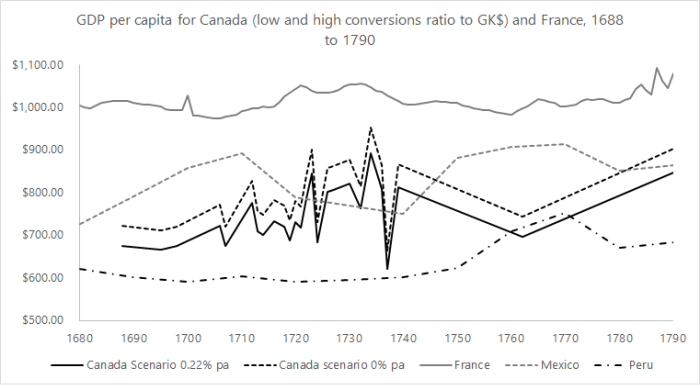
This is where Canada comes in. Today, the country easily fits in the “relatively rich” group. According to the figures 1 and 2 in the work of Acemoglu, Johnson and Robinson, it would have been in the “relatively poor” group well behind countries in Latin America. However, I recently finished compiling the Canadian GDP figures between 1688 and 1790 which I can now compare with those of Arroyo Abad and Van Zanden for Peru and Mexico. With my Canadian data (see the figure below), we can see that Canada was as poor as Latin America around 1680 (the start date of my data).

GelosoGDP.png

So, Canada was a relatively poor country back which was equally poor (or moderately richer) than Latin American countries. Why does that matter to the reversal of fortune story? Well, with the urbanization data, one shows that the non-urbanized of 1500 are the rich of the today. With the GDP data for the 1680s, we see that the more urbanized countries were also poorer than the less urbanized countries.

Now, my argument is limited by the fact that I am using 1680s GDP rather than 1500 GDP. But, one should simply extend the urbanization series to circa 1700 and the issue is resolved.  In any case, this should fuel the skepticism towards the strength of the reversal of fortune argument.