Race as a bundle and its implications

As I mentioned in my last post, I have been given the topic of race increased thought recently.

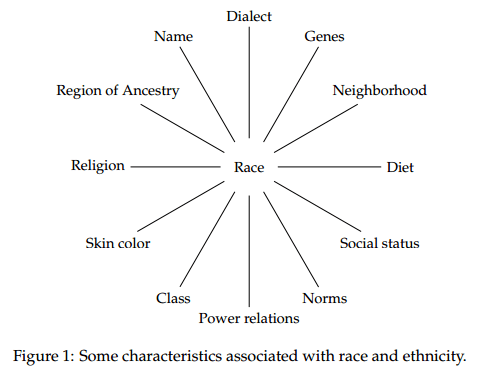
One of the recent developments in political science has been thinking of race not as a dichotomous variable, but as a bundle of related but distinct characteristics. Race is not simply phenotype, but a mixture of such things as one’s dialect, diet, and socioeconomic status among other things.

RaceBundle

The idea to me seems obvious, which makes me inclined to believe it. The thing is, if we take this broader approach to what race is, what are the implications for prior work not only in regards to race but the effect of demographic characteristics generally.

Race is already difficult to conduct research in because it is assigned at birth which makes it difficult to manipulate and which influences other characteristics we would ordinarily ‘control’ for in statistical analysis. To my knowledge there isn’t a ‘race ray’ that we can use to randomly assign being ‘black’ in an experiment. Tracing causality is possible, but difficult enough even in ideal situations.

Take for example the gender wage gap argument. When you control for education, presence of children, and other characteristics the gap in wages between males and females vanishes. However many of these characteristics are impacted by one’s gender. While females are not discriminated against ceteris paribus, being female does increase one’s likelihood of having to be the primary care taker for children and has historically decreased educational outcomes. In this broader sense there is a gender wage gap.

What can be done about it though? Men can try to share more of the house duties with their wives, but my general observation in life has been that children prefer being cared for by their mothers over their fathers. Should we try to do something about it? Are there advantages to one member of the household specializing in housework?

Or, if you prefer to think of the question purely in regards to race let us consider crime rates by race. I am not convinced that blacks have any higher propensity to crime than whites. However blacks are more likely to grow up in poverty and have lower educational outcomes than other races, which in turn leads to higher crime rates statistically speaking. Where should the arrow of causality be pointed towards: race, education, socioeconomic status?

Race is a difficult concept to think about. However it is precisely the difficulty with discussing it which begs that it be thought about more. I believe we liberals have a particular duty to think about race more because if we don’t then our ideological rivals will continue to dominate the conversation.

See here for an un-gated draft of the relevant paper: Sen, Maya, and Omar Wasow. “Race as a Bundle of Sticks: Designs that Estimate Effects of Seemingly Immutable Characteristics.” Annual Review of Political Science 19 (2016): 499-522.

3,278 Americans Are Serving Life Sentences for Nonviolent Crimes, Report Says

Around 79 percent of the nonviolent life sentences without parole are drug-related, according to the ACLU, and around 20 percent are for property crimes. The remaining 1 percent are for traffic and other infractions in Alabama and Florida”

This seems like as good an opportunity as any to talk about libertarian law.  First of all, to the libertarian, there is no such thing as non-violent or “victimless” crime.  There can be no “crime against the state” or “crime against society” since there would be no state and “society” is an abstract concept that cannot be a victim.  Crime can only occur when there is a clear perpetrator and a clear victim.

This is the logic used to deduce that there can be no punishment for consuming or selling drugs for example.

Second, libertarian punishment is confined to the concept of “proportionality”.  Proportionality is described by Murray Rothbard as:

“…the criminal, or invader, loses his own right to the extent that he has deprived another man of his. If a man deprives another man of some of his self-ownership or its extension in physical property, to that extent does he lose his own rights.  From this principle immediately derives the proportionality theory of punishment-best summed up in the old adage: “let the punishment fit the crime.””

Walter Block famously expanded on this concept with his “Two Teeth for a Tooth” rule saying:

“In encapsulated form, it calls for two teeth for a tooth, plus costs of capture and a
premium for scaring. How does this work?

Suppose I steal a TV set from you. Surely, the first thing that should occur when I am captured is that I be forced to return to you my ill-gotten gains.

So, based on the first of two “teeth,” I must return this appliance to you.

But this is hardly enough. Merely returning the TV to you its rightful owner is certainly no punishment to me the criminal.

All I have been forced to do is not give up my
own TV to you, but to return yours to you.

Thus enters the second tooth: what I did (tried to do) to you should instead be done to me. I took your TV set;
therefore, as punishment, you should be able to get mine (or some monetary equivalent). This is the second tooth.2″

The claim is often made that a libertarian society would be less just for the poor and disadvantaged but take this list of crimes that caused human beings to be sent to prison for the rest of their lives and compare it to the logical corresponding punishment called for by the proportionality rule and tell me which is more just.

“Among the most obscure offenses – mostly from Louisiana and Mississippi – documented in the report as the impetus for life sentences:

  • Possessing stolen wrenches
  • Siphoning gasoline from a truck
  • Shoplifting a computer from WalMart
  • Shoplifting three belts from a department store
  • Shoplifting digital cameras from WalMart
  • Shoplifting two jerseys from an athletics store
  • Breaking into a parked car and stealing a bag containing a woman’s lunch
  • Stealing a 16-year-old car’s radio
  • Drunkenly threatening a police officer while handcuffed in a patrol car”

Про политику народных волнений в России

С недавних пор в России стала очень популярна новая форма диалога с властью, которая получила название “народный сход”. В последнее время подобные акции случаются все чаще и чаще и носят все более спонтанный характер. Как правило, это несанкционированные митинги, которые зачастую переростают в погромы и столкновения с полицией. Буквально несколько дней назад в Москве прошел такой народный сход на волне резонансного убийства одного из местных жителей мигрантом с Кавказа.

Не буду рассказывать про толерантность, терпимость к незаконной миграции и засилью приезжих с Кавказа. Местное население устало, правительство считает, что “все нормально”. Другое дело, что градус эмоционального накала уже настолько высок, что достаточно малейшей вспышки, чтобы произошел взрыв. Район, в котором произошло убийство, славится своей овощной базой, которая по мнению местных жителей является центром этнической преступности. Не сложно догадаться, во что вылился народный сход: погром овощной базы, перевернутые автомобили, столкновения с полицией, 400 арестованных и так далее и тому подобное.

Убийцу-то поймали в конечном итоге. Но самое интересное не в этом. После народных волнений началась массовая проверка приезжих и незаконных мигрантов, несколько полицейских чиновников лишились своих мест…

Неужели власти надо каждый раз давать пинок под зад, чтобы она поняла: у населения кончается терпение. Как осел – пока не повесишь морковь перед носом, он никуда не пойдет. В данном случае роль морковки выполняют народные сходы. Это грустно.