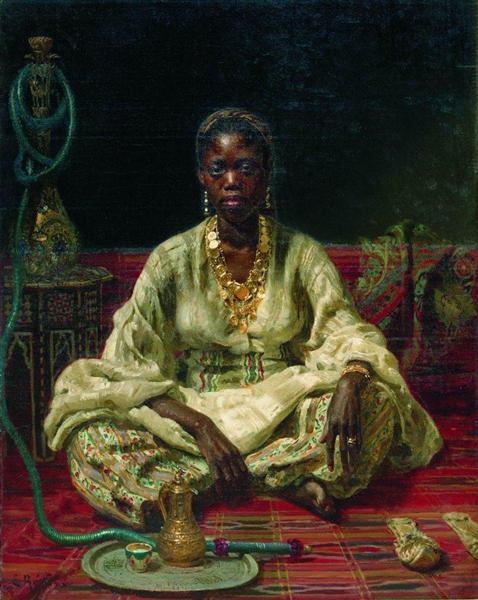
This is from Russian painter Ilya Repin:
Share this:
- Email a link to a friend (Opens in new window) Email
- Share on Facebook (Opens in new window) Facebook
- Share on Bluesky (Opens in new window) Bluesky
- Share on X (Opens in new window) X
- Share on Reddit (Opens in new window) Reddit
- Share on LinkedIn (Opens in new window) LinkedIn
- Share on Tumblr (Opens in new window) Tumblr
- More
- Share on Mastodon (Opens in new window) Mastodon
- Share on Telegram (Opens in new window) Telegram
- Share on Pinterest (Opens in new window) Pinterest
- Share on Nextdoor (Opens in new window) Nextdoor
- Share on WhatsApp (Opens in new window) WhatsApp
- Share on Threads (Opens in new window) Threads
- Print (Opens in new window) Print
 Notes On Liberty
How about a Delacroix (Eugene)? Or a better Caravaggio?
Cool. Got any specific requests?
Caravaggio: The Calling of St Matthew, the Beheading of John the Baptist. Delacroix: The Death of Sardanapulus; Christ on the Sea of Galilee; the Inside of a Harem…. Thanks.
I’m just free associating here, but on seeing this painting, I couldn’t help thinking of the debate between Bernard Lewis and Edward Said on Orientalism. Famously (or notoriously), Said had narrowed the focus of his study mostly to Anglo-American-French Orientalism, ignoring German and Russian/Soviet Orientalism. That focus extended to his very brief comments on painting:
Said: “Later in the nineteenth century, in the works of [Eugene] Delacroix, and literally dozens of other French and British painters, the Oriental genre tableau carried representation into visual expression and a life of its own (which this book unfortunately must scant). Sensuality, promise, terror, sublimity, idyllic pleasure, intense energy: the Orient as a figure in the pre-Romantic, pretechnical Orientalist imagination of late eighteenth century Europe was really a chamelonlike quality called (adjectivally) ‘Oriental.'” (pp. 118-9)
Lewis had responded that Said’s omission of German and Russian/Soviet sources was a serious defect in the book. Said claimed that it wasn’t.
But whether defect or not, it was an omission. You get the sense from reading Said that “Orientalist” painting was distinctive to the Anglo-French encounter with the Arab Near East, but your Russian/Balkan paintings prove that it obviously wasn’t. Not a large or original point, just one that happened to strike me just now.
This is basically what I thought when I came across this painting, too. It’s crazy how great minds think alike! (I came across Repin while I was doing some follow-up research on Gogol after I read his Dead Souls.)
This essay mentions a couple of Delacroix paintings of this genre, “Massacre at Chios,” and “Death of Sardanapalus.” “Women of Algiers” is another one, but not as good.
https://www.metmuseum.org/toah/hd/euor/hd_euor.htm
I don’t think of Caravaggio as belonging to this same Orientalist genre, even though so many of his Biblical paintings are set in the Near East. His Judith beheading of Holofernes looks like a nice Italian girl to me.
Sorry, I meant to say “his Judith beheading Holofernes looks like…” Strike the “of.”
[…] From Caravaggio, one of Jacques’ favorites: […]
[…] Delacroix requested Delacroix so, here you go: […]
[…] From Eugene Delacroix, as requested by Jacques Delacroix: […]
[…] Eugene Delacroix, as requested by Jacques Delacroix (no […]