After a year of being shocked by Trump’s behavior, people are now finally out of meaningful things to be upset about. We’re down to “Trump isn’t going to accept the results if he loses?!” The tone on the FiveThirtyEight elections podcast (mostly from Clare Malone) was “How dare he?! He must accept the outcome of the election!”
He’s not going to storm the White House, he’s just going to be a sore loser. Why, at this point, should we expect him to lose gracefully? What benefit would that give anyone? He’s not weakening institutions, just being a big baby. We shouldn’t be surprised!
I’m not saying that Trump gets an out because he’s exceptional. I’ve got two related points: 1) Good deeds lose their meaning if they weren’t done by choice. We don’t have to celebrate him being a sore loser, but we shouldn’t try to stop him (whatever that might mean) either. 2) If you aren’t free to be wrong, you aren’t free. Yes, democracy isn’t actually about freedom, but we are still trying to be a free country.
You’d think that as long as we’ve known Trump and Clinton it would be more obvious which is better (okay, least bad). But here we are. That said, I largely agree with Brandon’s thoughts: Hilary is the better of the two. If we’re thinking about the trajectory of freedom in this country, it’s like we had been climbing an upward path till 9/11 gave military-industrial complex a new project. Clinton is offering to keep leading us down a gentle incline and Trump is saying “let’s go through that thicket of poison oak!”
I stand by my old advice that a vote for the big two parties is a wasted vote. People will argue that in swing states it might be close and you might regret your vote. Those people are really arguing that you might regret the vote of hundreds-thousands of strangers. Your vote still is not decisive. Even if you convince a thousand strangers in a swing state to vote your way, you’re still highly unlikely to affect the outcome.
I think, in terms of voting, you do much more good by sending a Johnson signal than you do by slightly increasing the margin by which Clinton wins (or slightly decreasing the margin by which she loses depending on your state).
But my advice is given in the context of a world where Johnson is expected to get 6% of the vote. That affects my cost-benefit calculus. What would it mean for the long-run success of liberty if Johnson were to actually win?
To build on Brandon’s third point (“Clinton is a lawyer and she knows how our government is supposed to work”), this isn’t just a competition to get into the white house. It’s a sales pitch that requires buy in from the electorate. If Johnson won the election, he’d be in the position of some newfangled gadget America bought on a whim. He could catch on, like the microwave, or sink like the Segway.
Truthfully, I’m not sure that scenario would be that good for freedom–I think Johnson is a pretty good voice for liberty, and a great thirdparty candidate. But if he actually won, I think he might be too different from the environment he’d have to operate in. It could turn people off of libertarianism for another generation.
But then, the point of your vote isn’t to pick the winner, it’s to express your political beliefs. You’ll do a much better job of voting by voting your conscience than by trying to vote strategically. So vote for Johnson, but root for Hillary… this time.
Insider trading feels unfair, but increases the efficiency of financial markets. A price should reflect an estimate of the future profitability of the underlying asset, and insider trading allows those with the most information to have more of an impact on that price.
The Supreme Court is currently considering a case that will determine how broadly to define insider trading. If the defendant loses, then cases where a family member of an insider benefits from a stock tip could be considered insider trading. If he wins, it will probably be much more difficult to prevent insider trading. But why should we?
Someargue that the possibility of insider trading creates a problem of asymmetric practicable information–insiders always know more, but if they’re allowed to act on that information, outside investors lose incentive to invest in potentially valuable projects. That may be, but does it justify prohibiting insider trading? No.
The problem of asymmetric information requires a commitment device, but that device doesn’t have to be one-size fits all. Let businesses and investors solve this problem themselves with contracts.
Most gun deaths are suicides. Many of these suicides would have happened were a gun not available, but many of them wouldn’t have.
Most gun homicides mostly affect young black men.
More guns does not equal less crime.
Gun accidents affect very few people.
Cost-benefit analysis would likely suggest improving safety other places would save more lives, given limited budgets. (e.g. changing attitudes on vaccinations)
A basic theme seems to be that government can do little on the margin to reduce gun deaths. Crime rates are uncorrelated with number of guns, or regulations in place. Upright citizens do not turn into Rambo when they see dastardly criminals mug little old ladies. Guns are actually sort of boring in practice.
It’s possible that the government could affect gun deaths with a comprehensive gun control policy backed by public opinion (the Australian option). But it would likely cost so much that you’d lose the budget and/or political capital to enact other reforms that would be less controversial and save more lives.
We don’t torture people in America, Todd. That’s called one of the amendments.
What about the second amendment? The real argument for the second amendment is that having armed Americans around is pretty practical in general, but also important to prevent tyranny. In practice, guns aren’t half as practical, in terms of personal or national defense as back then. The capability of America’s military is so extraordinary that American’s don’t stand a chance of fighting a corrupt American government.
Let’s acknowledge that the Bill of Rights, though surely important, is ultimately a piece of paper that is neither sacrosanct nor a practical guarantee of anything in particular. The founders were brilliant, but fallible. The constitution is frequently ignored by governments, and citizens often do little to discipline such governments. Second amendment advocacy is mostly a symbolic gesture that probably comes at the expense of using political capital to protect the fourth amendment (the one that should protect you when the government decides to take your guns, cold dead fingers or no).
Conclusion
There are weak arguments to made in favor of gun control and weak arguments to be made in favor of protecting the second amendment. But mostly this whole debate seems like a distraction from more important issues. Symbolically valuable? Sure, but at what cost? The cost is the political will to make a bigger difference somewhere else. There are more valuable freedoms to protect, better interventions to pursue, and more lives to be saved.
There’s a simple alternative to regulation: liability. We don’t need to tell companies how to be safe if we make them legally responsible for negligence.
It’s as though Mass’s government decided that back-to-school season calls for creating real-life rent seeking examples for my class. They’re going to start taxing ride-sharing customers $0.20 per ride with five cents of that going to the taxi industry.
“The law says the money will help taxi businesses to adopt ‘new technologies and advanced service, safety and operational capabilities’ and to support workforce development.”
New technologies like an app that gets more use out of otherwise idle cars? Or an app that makes it easy to hail a ride with little wait? Or an app that brings supply into harmony with demand when demand surges? Oh wait! We’ve already got that and it’s the thing that’s being taxed!
There are a few important economic lessons that Massachusetts’ electorate is evidently in need of. Let’s start with taxes.
Taxes don’t stick
“Riders and drivers will not see the fee because the law bars companies from charging them.” They won’t see the fee, but that doesn’t mean they won’t pay it. A business only exists by collecting money from customers and paying some portion of that to suppliers. The government cannot tax a business without taxing that business’s customers and suppliers.
Granted, part of the cost will be reflected in lower profits (although profits aren’t as big as people think) which means Uber’s shareholders will face part of the tax. But what does that mean? It means 1) a little less money in pensions, and 2) potential investment capital is moved from the people who gave us the best version of taxi travel to the people who gave us the worst version of it.
Money is fungible and I don’t know how to run a cab company
Safety, new technology, and workforce development all sound good, but taxi companies (at least those that deserve to stay in business) will already be doing these things. Safety is important because accidents are costly (especially if your fleet size is limited by regulation). New technology is being adopted by every other (competitive) industry without government support. Other companies invest in their employees.*
Supporting workforce development is part of a larger trend of people supporting specific fringe benefits without appreciating the tradeoff between monetary and non-monetary compensation. And all these ideas reflect a faulty logic: just because something is good, doesn’t mean we need to force people to do it.
Voters simply aren’t in the right position to know if some good thing is good enough relative to other options. If you go into the backrooms of any industry you aren’t already familiar with you will surely learn about techniques and tools you had no idea existed before. So why should we expect that cab companies need regulators to tell them what to do? Let them learn from their trade magazines.
But there’s good news. If we mandated that cab companies use this new revenue stream to pay for new tires, they wouldn’t simply waste the money by buying superfluous tires. They’d stop buying tires out of their own revenues and start buying them from Uber’s. Telling someone to pay from their left pocket simply leaves more money in their right pocket for everything else.**
Extra money in cab company coffers could allow them to invest in better service, happier employees, “and help so taxi owners could buy ‘flagship’ vehicles like a 1940s Checker or a Porsche.” But cab companies are already free to reinvest their profits if they think doing so would create value (i.e. greater future profits). The more likely outcome is that they will simply have more money than before.
Competition is not the problem, it’s protectionism
When we see problems in the world we need to look for their root causes if we want to actually make things better. More often we act like a doctor diagnosing cancer is the cause of the cancer. Don’t want cancer? Outlaw doctors!
Cab companies aren’t as successful as they previously expected and the apparent culprit is Uber. But they only exist because an inefficiency in the market created a profit opportunity. Cab companies are doing poorly because they don’t provide as much value per dollar. And that’s largely because of regulation that prevents competition. Much of it was put in place specifically to protect incumbents from competition.
A lot of these regulations sound nice enough, but they still created the market niche that Lyft and Uber filled. And they protected cab companies from competition right up until ride-sharing became feasible.
Regulation is not the answer
Let’s give cabbies the benefit of the doubt for a minute. Let’s assume that they aren’t really in it for the cash-grab and that they just want to help people get around safely and conveniently. Let’s even assume that NYC’s medallion system is about congestion rather than competition.
If that’s the case, then there are better ways to address the root causes of the problems cabbies tell us to worry about. We don’t need to address each of these problems individually if we can find a few key causes at the root of each of them.
Cabs have medallions but civilians don’t, so congestion will still be a problem in cities until congestion fees are implemented that balance the demand for road access with its limited supply. Safety is important, but mandating extra inspections for only some types of cars is a half-assed way of dealing with it.
There’s a simple alternative to regulation: liability. We don’t need to tell companies how to be safe if we make them legally responsible for negligence. This is an important lesson for how we think about regulation in all industries. The basic logic is also why economists vastly prefer pollution taxes to specific regulations; it’s usually better to name the outcome we want and create a cost for failure to meet it rather than mandate specific behaviors.
Perhaps this means we should modify the laws that require all drivers to be insured so that some drivers have higher minimum liability coverage. That would be far less invasive and do far more to alleviate the concerns Uber’s critics raise than mandating specific behaviors.
Concentrated benefits dispersed costs
Okay, so maybe this is too small an issue to be concerned with. If that’s not by intentional design, then it at least reflects an evolutionary logic. This policy is likely to survive because the people it taxes will face a cost so small it isn’t worth doing anything about. Yes, Uber and Lyft have incentive to lobby against it, but it’s so close to invisible that they’ll probably be able to pass it almost entirely on to drivers and passengers.
This is going to cost millions… with a tiny little m. At first I read it as a 5% tax and quickly realized that Uber rides are so cheap that I won’t even notice it. And 20 cents a ride is even less than 5%.
So why worry? Precedent. The problem with death by a thousand cuts isn’t any one cut.
*Of course we can argue about whether they do enough of that. There may be a tragedy of the commons if there’s asymmetric information between people looking to make human capital investments and businesses looking to gain access to specific human capital. Such a situation might create an opportunity for government to do some good by investing in public goods or subsidizing on-the-job training. But if that’s the case, it calls for very different programs (education reform, etc.) than taxing successful companies to subsidize their competition.
**Why is this good news? Because if cab companies did change their behavior it would imply they’re doing something where cost exceeds benefit. It would destroy value. Remember those stories of WWII rationing? Imagine that situation but with cab companies buying twice as many tires and just storing extras in the garage. It would clearly be a bad thing. Scarcity isn’t so urgent nowadays, but the basic logic remains the same.
Five Thirty Eight had a disappointing discussion of an interesting issue: the cost of child care for working parents. The basic issue is that kids are expensive in time and money. Unfortunately, the discussion mostly revolved around questions of how to engage in economic engineering by government in order to expand access to child care and parental leave.
The hosts see these policies as having costs and benefits, and they see the value in studying alternatives empirically, but they miss an important issue: providing these sorts of goods doesn’t require screwing up markets by adding an extra layer of complexity to the tax code. If these goods are worth providing (that’s another couple of cans of worms) then just give money to new parents. Better yet, move to a basic income guarantee.
Another important point they miss is that if some good is difficult to get, it’s worth figuring out what to do about the root problem rather than just throwing money at the issue and hoping someone will figure out the important stuff later.
This post is for Democrats and Republicans, not libertarians. Let’s take it for granted that we want to help poor people and we’re willing to use the coercive power of government to do so.* The trouble with the interventions below is so troubling that we don’t even have to bother about having a deep philosophical debate. I’m not trying to change your destination, I’m just trying to get you to get out of that explosive Ford Pinto.
Minimum wage, water pricing, education, and just about all of American health care finance involves distorting markets to give charity and/or gifts. Essentially, they change rules so that group X pays Y instead of Z with the hope that X can afford it and Z can do more good with the money than Y. But this indirect giving has serious flaws.
Take the case of the minimum wage: it’s supposed to help the working poor by making their boss and consumers pay a bit more for their services. Of course it might simply be to help interest groups, and that further raises the burden of proof for those who would prefer a minimum wage to less invasive alternatives.
So what is this less invasive alternative? Cash transfers. We’ve already got some imperfect versions of this. School vouchers, food stamps, and a host of other welfare programs. What I want to see is a simpler version that takes the best features of these programs to eliminate the problems created by market interventions.
The economics of this proposal are simple and important. Prices are essential to help people use resources wisely. Interfering with the market process makes those prices less effective at communicating information about value and opportunity cost. And with an interconnected markets, a small price control can lead to worse decisions being made all across an economy.
Simple economics tells us that if we impose a minimum wage (or give special tax treatment to XYZ, or whatever) then something’s got to give. It might be higher unemployment, it might be worse working conditions, or it might simply be that rich people are a little less rich than before.
(It’s worth remembering that rich people are people too; even lawyers. They can do good and bad things, and those actions determine their moral quality, not their wealth per se… we don’t want to redistribute wealth for its own sake, we want to do so if/because we think it will do some good. The hope is that the harm of a few bucks out of your pocket does more good for the poor people who get that cash. And no, it’s not possible for “corporations” to suffer; corporations aren’t people, but they are owned by people.)
Consider the case of feeding the poor. It’s not hard (even for non-economists) to imagine how imposing price controls on food could lead to shortages. If there’s one thing we learned from socialism, it’s that bread lines are bad. Food stamps are a much simpler and targeted solution.
We should prefer straightforward transfers over market intervention because it will do more good at less cost. More importantly, it is humbler–distorting markets requires a lot of information, transfers don’t.
Transferring money rarely jives well with American intuition, and that brings up an important bundle of issues: responsibility and social engineering.
Republicans, for all their talk about the importance of individual responsibility, seem unwilling to let the poor exercise it themselves. They’re sure that enough poor people will abuse the system that some bureaucrat needs to exercise responsibility for them. Similarly, Democrats want to ensure the dignity of the poor, but how is anyone supposed to remain dignified while navigating labyrinthine bureaucracy?
The left should like cash transfers because they can help those we want to help, and take advantage of the information available to those with intimate knowledge of their context. The right should like it because it can replace a series of bloated bureaucracies while returning responsibility to the poor. Everyone should like that it will be cheaper and more effective than what we’ve currently got while creating better prospects for long-run economic growth.
We should absolutely debate whether specific transfers are a good idea (particularly middle-income to middle-income transfers like higher ed subsidies, mortgage interest subsidies, etc.), but for those programs we ultimately take on, we shouldn’t shoot ourselves in the foot by trying to do good by screwing up markets.
*As an economics professor I get to see what economic superstitions recent high school grads have. I’m struck with the confusion between the health of government and the health of the country a government is supposed to be helping. A related pair of confusions is that what a government can do, it should do; and if something isn’t already happening, and might be nice, government should make it so.
Missing from these superstitions is that the fundamental feature of government is force. What differentiates government from any other non-profit organization, is that charities and associations can’t put you in jail if you choose not to behave as they see fit. But for the sake of clarity, let’s put aside that issue and just focus on how the government can help the poor.
My best (uninformed) reading of the data is that gun ownership is slightly positively correlated with successful suicide attempts but little else, and that sounds about right to me. I’ve met (other) gun owners, and for the most part they aren’t likely to turn into Rambo in an emergency situation just because they’ve got a sweet gun.
But the 30 seconds of Facebook commentary on this last event before I had to close the tab led me to a revelation. I’ve said before that there’s no such thing as no gun control. Throw that together with the notion that government is a monopoly on coercion, and you’ve got my recent insight: a liberalized gun policy is equivalent to deputizing just about everyone.
Frankly, if I threw a Nerf ball into a crowd, I wouldn’t be likely to hit someone who should own a gun, but I also wouldn’t hit someone who should vote. (That hypothetical person’s vote would probably do more harm than their gun.) And that responsibility problem is similar in both cases. Everyone should have a right to vote and own a gun, but both rights should come with a heavy responsibility.
I can imagine a universe where the bouncers are armed and deputized as a routine matter. And I think that in such a world it would be relatively easy to have a liberalized 2nd amendment combined with a cultural understanding that a gun is a powerful tool to be wielded carefully rather than an entitlement.
The Right would do well to focus on their strong point here: responsibility is key. And the Left as well: barbaric intolerance is bad. Both sides confuse amoral tools with moral judgments.
Like many pack animals, I judge the hell out of the idiots surrounding me. It’s impossible not to have immediate gut reactions when we see our neighbors making stupid decisions; our brains are hard-wired to be nervous about how wisely our tribe used scarce survival resources. And let’s face it, it’s fun to make fun of doofuses in vinyl wrapped electric Hummers.
A couple semesters ago I asked my class for examples of useless things and landed on tabloid articles about Chloe Kardashian. Surely that’s one thing our economy can save some cash on without any real harm.
But it’s not so simple. Nobody is being forced to print those rags which means someone (bless their hearts) wants to read about Chloe Kardashian. And they want it enough that they’re willing to work for it.
If you set up an amateur print shop in your basement and made up a bunch of celebrities to gossip about as a hobby, nobody would have any reason to stop you. We may agree that your hobby is silly, but if you can’t have a silly hobby, then what’s the point of it all?!
When people buy those magazines at the check out counter, they’re putting their own effort into making up celebrities to gossip about, the difference is they don’t have to put in so much time and the production value is higher because of gains from trade.
Even silly things have moral worth when they exist because of people’s voluntary choices. We should all be more hesitant to ban behaviors we don’t understand.
While googling a phrase to see if I’m creative (I don’t know if “Hayekian leisure class” is uniquely mine, but the first page of Google’s 78,000 results indicates yes), I found this interesting tidbit: Thorstein Veblen’s house sold (way back in 2004) for $1 million.
The developer is going to (already has? Already started to then went bust?) tear it down and build some sort of luxurious suburban palace. Ironic, but not as ironic as it could have been. Far more Veblenesque would have been leaving it standing as a conspicuously authentic status item.
I can’t find the specific house, but narrowing down to its area on Zillow (based on Internet commentary) leads me to believe that the property has been folded together into a larger lot, but would hypothetically be worth about $2 million today.
This week’s episode of EconTalk was fantastic, and in particular drew an important parallel between the complexity of the human brain and the complexity of market economies. The guest was discussing radical nanotechnology (basically the idea that engineers could out do bacteria by applying good design principles in place of random mutation and natural selection), and Russ pointed out that the logic is basically the same as in Socialism. Radical nanotechnology runs into a fundamental problem as long as it ignores the emergent processes occurring at the molecular/cellular level.
Later, the guest discusses the issue of artificial intelligence and points out that the fundamental unit of biological computing is not the neuron (which we simulate on computers using neural networks), but the molecule. In other words, natural intelligence is the outcome of a complex process that isn’t simple enough for us to easily replicate on a computer.
All that in mind, the idea of socialism* is like the idea that we could replace a brain with a pocket calculator. Yes, the idea is to get a very powerful calculator, but the problem is that it’s replacing a computer that’s far more complex and sophisticated.
* i.e. Centralized control of the means of production… socialism has nothing to do with sharing (you’re thinking “Egalitarianism”) and everything to do with control, and particularly the attempt to rationalize complex systems.
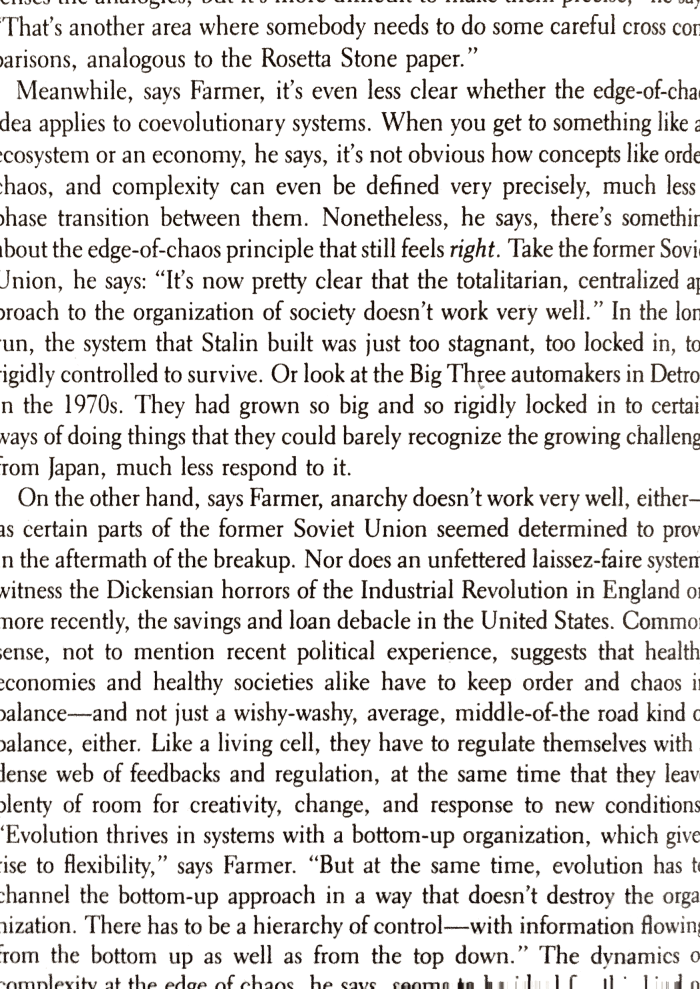
This book was written in 1993 so I’m pretty late to the show, but it’s worth raising the issue: complex systems require governance, but that need not mean government.
In the copy below the author is writing about how complex systems–systems with components that affect one another in simple ways resulting in emergent orders at the system-wide level–occupy an interesting space between chaos and order. Too much order and you end up with something fixed and unchanging. Too much chaos and you’ve got noise.
The second full paragraph misses an important point that should have been obvious to the author and the researchers who he’s paraphrasing. The government is an endogenous element in the wider economy. If we think of the economy as a network of people (individual nodes) who cluster into sub-networks (organizations), the government is just a collection of nodes and clusters that follow different rules than the rest. Granted, these clusters often serve important roles (e.g. courts). But the anarchist branches of economics have pretty clearly demonstrated that removing the state from these roles doesn’t always lead to chaos. Ripping the state out like a band-aid would be an awful idea, but gently scaling (scoping?) back the state need not be a disaster.
This band between chaos and order is wider than they’re giving it credit for. We can only examine this band from our own perspective… as human beings who are tiny components of this much larger network of networks. The range of configurations that could allow a peaceful, flourishing society is essentially infinite. Yes, governance is necessary, but strengthening any particular set of nodes cannot allow for governance of the system as a whole. It can only allow for governance of a sub-set of the wider network.
pp. 171-172 of Competition and Entrepreneurship has J.K. Galbraith asserting, “that independently determined consumer desires [do not] dictate the pattern of production. The ‘institutions of modern advertising and salesmanship…cannot be reconciled with the notion of independently determined desires, for their central function is to create desires–to bring into being wants that previously did not exist.'”
Beyond the obvious first step (recognizing that consumers’ desires could not possibly be determined independently of the market process), this raises an interesting hypothesis: Advertisers should a) recognize that they’re selling snake oil and consume significantly less than similar people, or b) be particularly excited about the prospects of new and exciting products generally. In either case advertising should affect them differently than regular consumers and they should consume a different amount than consumers generally. At the very least, their consumption patterns should be different from regular consumers in the particular goods that they are advertising.
The criticism of advertising as socially wasteful (i.e. using up resources without actually making consumers better off) may hold up if evidence is found in support of the above hypothesis. In the case of pattern ‘a)’ it may be clear that advertising is manipulative and anti-social. But in the case of pattern ‘b)’ or the null (advertisers buy the same junk as the rest of us) we either have to abandon the criticism of advertising or come up with some ad hoc story about how everyone is stupid and their preferences shouldn’t matter.
Whoa! Yeah, I’m going to do this, but let me start with some caveats. First, this is an argument, not the argument. Every silver lining has a storm cloud, and acknowledging the silver lining doesn’t mean you’re in favor of tornadoes. Second, I’m being sloppy with the term libertarian; classical liberal is closer to the truth, but doesn’t make for as good a title. Most importantly, I think my argument is swamped by the traditional libertarian arguments against the FDA. All that said, this argument has some interesting implications for how we think about intervention generally. Here goes…
The human body is a complex system that we do not fundamentally understand. Although every complex system is unique, they have similarities. In the case of both the human body and society/markets, interventions lead to unintended consequences which can offset the (ostensible) gains from the intervention. At the end of the day, although the FDA intervenes in the complex system of human society, it also prevents intervention in the complex system of human physiology.
The Hippocratic Oath instructs its speaker to not play God and to avoid over-treatment, and the justification for that is made clear in a recent Econ Talk. The guest was on to promote his book which discusses the problem of medical reversal–the phenomenon of medical practices that are adopted and subsequently abandoned after evidence shows the practice to be ineffective or worse. From this position he argues that the FDA’s mandate to ensure not just safety, but efficacy, is especially important. His argument is that because of the cost of type II error the FDA ought to go further.
Let’s look at two extreme cases. In the “anything-goes” world, we might have a lot of people trying good and bad interventions with a lot of harm being done to the unlucky ones. You and I know that the real problem is one of information and that in a perfect world we would have “anything-goes-that-consumers-with-access-to-good-information-from-Consumer-Reports-®-or-a-competitor” but this world still leaves us with the problem (which we face in today’s FDA-evaluated world) that consumer trial-and-error is a poor substitute for randomized control trials.
At the other extreme we have the “first-do-no-harm-second-do-real-good” world of an ideal FDA. This world has very steep type I errors but instead of two steps forward, one step back, we would have one step forward, then another, and never any steps back…. but of course each step forward would cost a few billion dollars.
Neither extreme is ideal, but the second world is one where standards of evidence are taken very seriously. In that world I’d be a third grade teacher instead of a college professor. The standards of evidence are at the core of the problem of medical reversal, but also the problem of economic intervention (which is far less likely to be reversed, even in the face of good evidence indicating that it should be).
As far as medical intervention is concerned, my position is bullish on better efficacy evaluation of medical procedures but still bearish on the FDA itself. But looking at the FDA from this angle opens up an interesting thought experiment: what might be the effects of an Economic Intervention Standards Authority? In practice it would probably be awful (my guess is a federal bureau that attempts to quash Tiebout competition), but in a libertarian utopia it would be the bureaucracy that libertarian kids with administrative bents would dream of heading.



 Notes On Liberty