Check out this sweet map of the Eskimo world today. It is broken down by linguistic groups. I wonder if these linguistic groups consider themselves ethnically distinct as well as linguistically distinct.
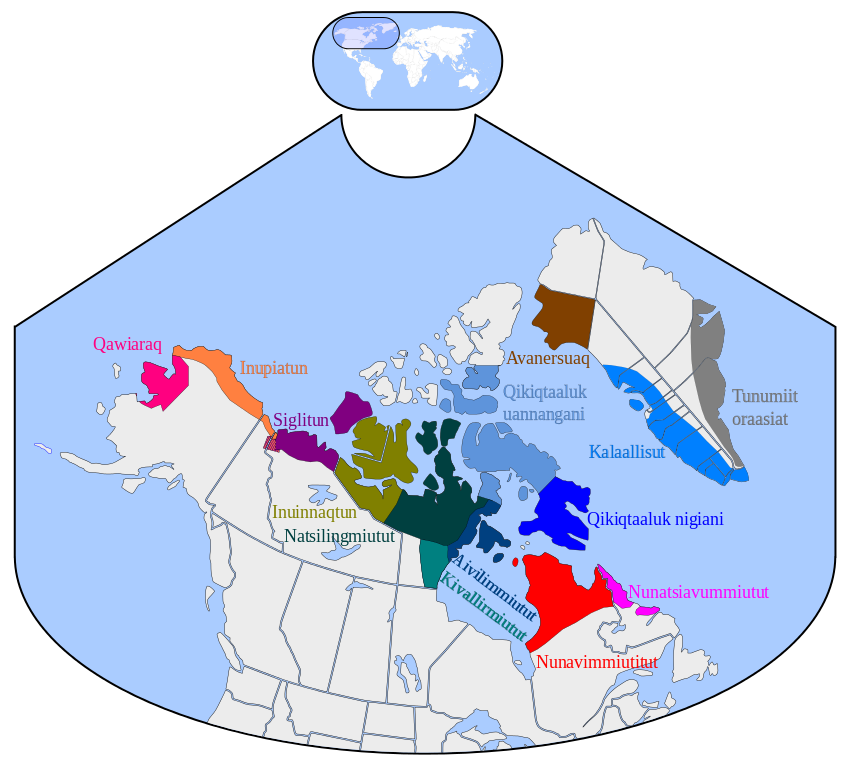
Here is a Wiki article on Nunavut, an experiment in Canada with indigenous self-governance (don’t get me started!).
And an article on Danish colonialism in Greenland (possibly gated).
Updated: I changed the title from ‘Eskimo’ to ‘Inuktitut’ because I just learned that the former is used as a pejorative term in Canada and Greenland (like the n-word here in the States). Inuktitut is term preferred by those highlighted in the map above. I’m not politically correct by any means, and in the US the term ‘Eskimo’ doesn’t carry any negative connotations, but being polite and being politically correct are two very different things.
 Notes On Liberty
“Together with Japanese and Korean which are major modern languages, these ‘poor relations’ resist any easy or obvious linguistic classification, either with other groups or with each other. Languages within the Paleo-Siberian group are thought by some to be related to the Na-Dené and Eskimo–Aleut families, which survive in slightly larger numbers in Alaska and northern Canada. This would back several theories that some of North America’s aboriginal peoples migrated from present-day Siberia and other regions of Asia when the two continents were joined during the last ice age.”
http://en.wikipedia.org/wiki/Palaeosiberian_languages
Fascinating. Thanks Hank!