For most of history, men tended to be more literate than women. In essence, illiteracy was widespread but even more so for women. There is one exception: the French-Canadians. For most of the 19th century, literacy rates were greater for French-Canadian women than French-Canadian men.
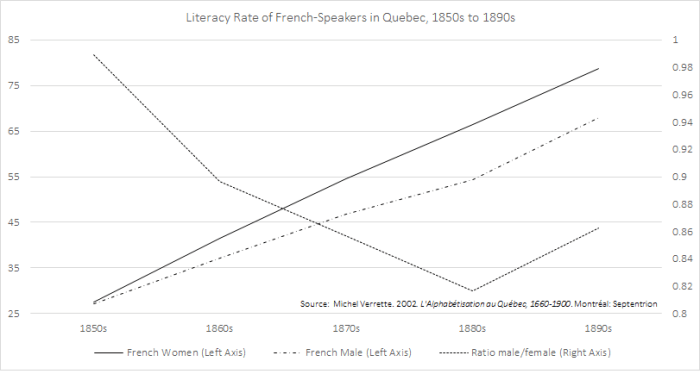
This is a fascinating piece of economic history and somewhat of a puzzle (given that it is an oddity). It also shows how important institutions are to determining paths of development. In a 1999 article in the Journal of Economic History, Gillian Hamilton indicates that the more “liberal” institution of marriage contracts for the French-Canadians probably induced this result :
Quebec’s unique legal institutions offered the opportunity to draw up a prenuptial contract to couples who could benefit from a different property structure than the law provided. Not surprisingly, a prenuptial contract was unnecessary for most couples. Within this transaction cost-competitive marriage market framework, contracts generally were desirable only in cases of mismatch, either due to an exceptional woman or a relatively productive husband whose job did not entail a significant component of family participation. Their contracting decisions are consistent with terms that would have provided them with more appropriate incentives for work and the production of jointly produced goods, and at least the potential for greater utility and wealth than they otherwise would have accumulated. The use of contracts likely provided Quebec with higher overall wealth and a wider income distribution than it would have experienced without contracts (because the skilled disproportionately signed agreements).
 Notes On Liberty
[…] High-Value Work and the Rise of Women: The Cotton Revolution and Gender Equality in China [pdf] | When (Where and Why) Women Were More Literate than Men […]